Is a copper water bowl safe for dogs and cats?
A solid copper water bowl is not for every pet. Which breeds and conditions need a vet's view first, and how to use and clean the bowl.
By LiveWell Earth
In this guide
A solid copper bowl is for fresh water only, refilled daily, and it is not for every pet: dogs from copper-sensitive breeds and pets with liver conditions or on low-copper diets should drink from another bowl unless their vet says otherwise.
What copper in water means
Bare copper releases small amounts of copper into water that sits against it. Two things raise the amount: time and acidity. Water that has stood in copper plumbing holds more copper than water that has just run through it, and acidic water draws out more 1.
One published study stored water in copper containers for up to a week. Copper in the water rose with storage time, from 0.009 to 0.823 mg/L 2. That study used its own water and vessels, so read it as a pattern, not a measurement of any bowl. The pattern is the useful part: water changed daily spends less time against the metal.
Copper is also an essential trace nutrient. For dogs, complete and balanced commercial diets already supply it. In a survey of 45 over-the-counter dog foods, none fell below the minimum requirement 3. A copper bowl is not a copper supplement. It is a water bowl, chosen for the material.
Which pets should drink from something else
Some dogs inherit a tendency to store copper in the liver. The condition is called copper-associated hepatopathy, or copper storage hepatopathy. For these dogs, every source of copper counts, water included 34.
Not recommended
Ask your vet first
- Labrador Retrievers
- Doberman Pinschers
- Dalmatians
- West Highland White Terriers
- Skye Terriers
- Keeshonds
- American Cocker Spaniels
Veterinary references link these breeds to copper build-up 356. It can also appear in other breeds, mixed breeds included 6.
Also ask your vet first if your dog or cat
- has liver disease or abnormal liver blood work
- is on a copper-restricted or prescription liver diet
One detail makes the vet's view essential. A dog with too much copper in the liver can seem completely healthy, with high liver enzymes on blood work as the only sign 4. If your dog's breed is on the list, ask even if all seems well.
For dogs already on a low-copper plan, veterinary nutrition guidance suggests testing your household water, because copper in water can add to what builds up in the liver. It notes that people with a similar condition are advised to avoid water above 0.1 ppm copper 4. Another reference suggests running the tap before filling the bowl in homes with copper pipes 3. A bare copper bowl works against both. Use a non-copper bowl your vet is comfortable with.
Cats
Copper build-up in the liver has been described in cats, but it appears to be rare 7. The 700 ml bowl is sized for cats: wide enough for comfortable drinking, low enough for easy reach 9. If your cat has liver disease or a history of liver problems, ask your vet before switching 9.
Water only
The bowl is for clean, fresh drinking water. Keep everything else out 9:
- kibble, wet or raw food
- water with apple cider vinegar, citrus supplements or broth
- anything your vet asks you to add to water; give that its own bowl
The reason is acid. Acidic contents increase copper leaching 9. U.S. model food-safety rules bar copper and brass from contact with any food below pH 6, such as vinegar, fruit juice or wine, because copper can leach into it 8.
Cleaning and patina
Every day, empty the bowl, rinse it with warm water and dry it with a soft cloth. Then refill. Hand wash only: dishwashers dull and pit bare copper. Skip abrasive pads 9.
The copper will darken. Over the first weeks it deepens toward antique bronze; by the second month the patina settles. That is uncoated copper behaving normally. A plated bowl cannot change this way 9.
Keep the patina, or restore the shine. Dip a wedge of fresh lemon in coarse sea salt, rub it gently inside, then rinse and dry 9. Rinse thoroughly. Lemon is acidic, and the bowl should hold nothing but water when you refill it.
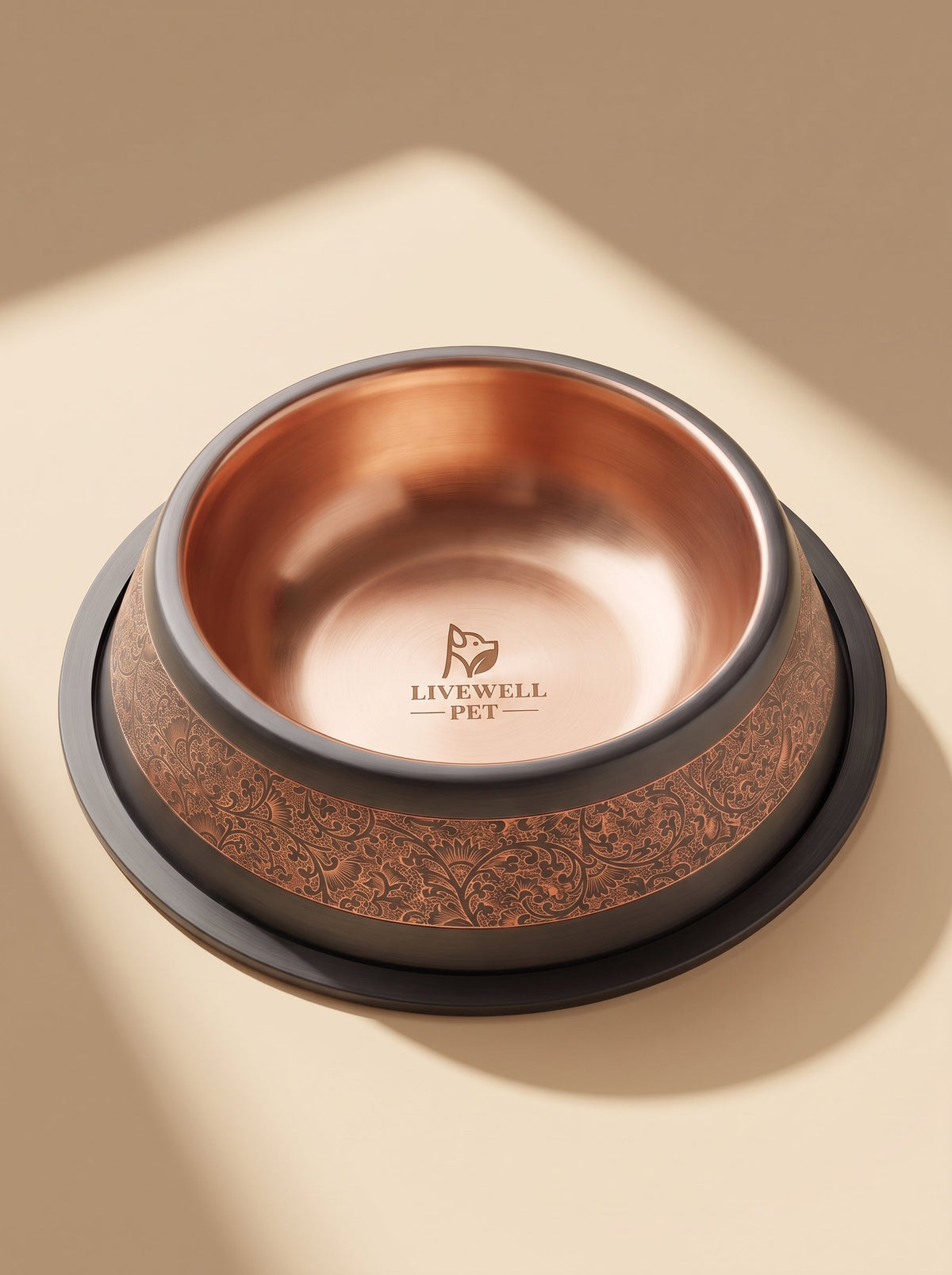
The enamel band sits on the outside only, so the water touches bare copper alone. The weighted base keeps the bowl in place: about 0.86 kg (1.9 lb) for the 700 ml and 1.0 kg (2.2 lb) for the 1 L 9.
When to ask your vet
- Before the first fill, if your dog's breed is listed above.
- If your dog or cat has liver disease or abnormal liver blood work, or eats a copper-restricted or prescription liver diet.
- If your vet has asked you to test your household water for copper.
- If your pet's drinking habits change. That is worth a visit with any bowl.
- Whenever you are unsure. When in doubt, ask. We would rather you be sure.
Choosing a size
The Longevity Pure Copper Dog and Cat Water Bowl comes in two sizes. The 700 ml (24 fl oz) suits cats and dogs under 25 lb. The 1 L (34 fl oz) suits dogs of 25 to 45 lb. If your pet is between sizes or drinks a lot, choose the larger bowl 9. Care for the whole line is on the copper-care page. See the rest of For Pets and the Copper Collection.
Questions before you buy: support@livewellearth.com.
Questions we get
Can I use the copper bowl for food? No. It is for fresh drinking water only. Food and acidic liquids stay out of it.
Why is my bowl getting darker? Bare copper takes on a patina with use, and that is normal. Lemon and coarse sea salt bring back the shine. Rinse well afterward.
Can it go in the dishwasher? No. Rinse and dry it by hand.
Sources
1. Chemical fact sheet: copper, Guidelines for Drinking-water Quality (2022) (PDF)
2. Manne R. et al., "Water quality and risk assessment of copper content in drinking water stored in copper container," Applied Water Science 12 (2022) (DOI 10.1007/s13201-021-01542-x)
3. Today's Veterinary Practice, "Nutritional management of copper hepatopathy"
4. Petfoodology (veterinary clinical nutrition blog), "Copper-associated liver disease in dogs"
5. Merck Veterinary Manual, "Copper toxicosis in animals"
6. Consensus statement on the diagnosis and treatment of chronic hepatitis in dogs (2019)
7. dvm360, "Copper-associated liver disease (Proceedings)"
8. Food Code 2022, section 4-101.14, Copper, Use Limitation (PDF)
9. LiveWell Earth, pet bowl product page (also read: copper-care, For Pets, Copper Collection)
More from the Journal
All guides
Copper Water Dispenser: Sizing, Setup and Care (10 L, 2.6 Gallons)
How much a 10-liter copper water dispenser holds, how many people one fill serves, how to set it up, and how to clean it by hand.

Copper peptides: what copper tripeptide-1 means on a label
What copper tripeptide-1 means on an ingredient list, why it sits where it does, and how to layer a copper peptide cream and scalp serum.